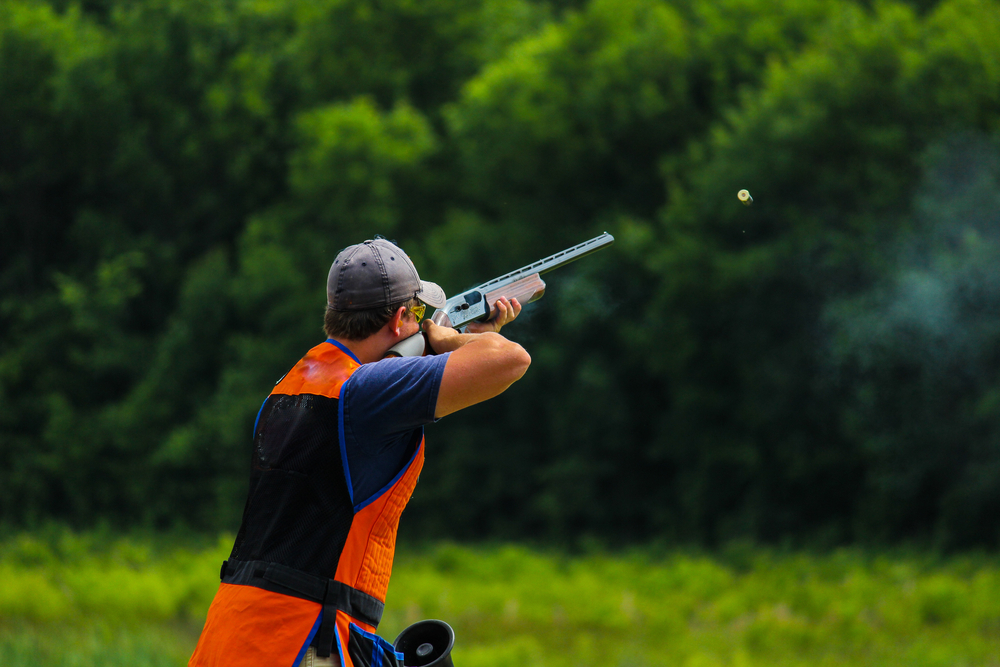
Trap shooting began back in the early 19th century as a way for hunters to practice shooting targets that simulated animals and birds. Eventually, a throwing mechanism was designed to throw glass balls filled with feathers into the air. When hit by a shot, the balls would burst in a very satisfying cloud of feathers. By the end of the 19th century, the clay target was developed, and this really opened the sport of target shooting to many more people who previously could not afford extensive weekends of hunting or the earlier glass ball trap shooting. Clay targets also became the target of choice, as they simulated the flight of a bird better than the glass balls. By the early 20th century, clay shooting had become a vastly popular sport, with national and international competitions as well as inclusion in the Olympic Games.
Three Major Shotgun Sports
Today, trap, skeet and sporting clays are the three major shotgun sports that involve shooting clay birds. While the sports were originally intended as a form of target practice for hunters (and still are), they are very popular among recreational gun enthusiasts and have developed into extremely competitive sporting events. The terms trap, skeet and sporting clays are often used interchangeably and confused in the modern sporting world, but all 3 sports have major differences between them.

Trap Shooting
One of the main differences of trap is that the clay birds fly away from the shooter. When shooting trap, shooters stand at one of 5 different starting positions and take shots at 5 clays from each of the positions for a total of 25 shots in a round. Shooters will take turns firing at a target, and after each has attempted 5 clays, they will all rotate around to the next position. Targets in trap generally fly at a predictable height, but at a variety of angles, giving the shooters a bit of a challenge. Shooters are allowed to fire twice at each target, and some will even fire a second shot at larger pieces of a broken clay bird, as they practice “staying in the gun.” With Olympic trap, the clays fly much faster and the clay direction and firing is controlled by a computer to ensure a fair contest.
Skeet Shooting
While somewhat similar to trap, skeet involves targets crossing from side to side. In skeet, there are two target boxes on either side of a semi-circle of shooting positions. Each shooter takes 5 targets from each of 5 shooting positions, much like with shooting trap. The target machines are roughly 40 meters apart and fire at an angle where they cross each other’s flight paths. One target launcher is known as the high house because it is 10 feet above the ground, while the other launcher, the low house, is 3.5 feet off the ground. The different heights of the clay bird launchers provides an added challenge to shooters, who have to adjust for varying heights of the birds being launched. Additionally, a round of skeet can be played in either singles or doubles; singles is played with single target presentations, while doubles has two target presentations.
Sporting Clays
Sporting clays takes a very unique twist on shooting clay birds, and it’s because of this that it’s usually referred to as “golf for shotguns.” With trap and skeet, shooters fire from designated stationary positions, but with sporting clays, shooters walk through a scenic course with each station offering various launching machines. Some machines might shoot a clay straight up into the air, while another can roll one across the ground. A round of sporting clays can take a couple hours to complete. The course typically consists of 10 to 15 stations with people shooting between 80 to 120 targets in a round. Sporting clays easily provide the closest in-the-field hunting simulation.
What Makes A Good Sporting Shotgun?
Virtually any shotgun can be used for sporting clays, skeet or trap. However, there are certain characteristics that are preferred by the most serious of sporting competitors because they offer slight advantages.
When it comes to breaking clays, most shotgunners use either a 12-gauge or 20-gauge shotgun, but it’s not uncommon to see shooters using 28-gauge or .410 bore shotguns. The smaller calibers are often used by younger or older shooters who are sensitive to higher recoils, or they are used by shooters seeking an added challenge, as smaller calibers throw less lead downrange, making it more difficult to hit clay birds. You’re best off using the highest gauge you’re comfortable with, keeping in mind how you react to recoil since you will be shooting quite a bit.
As far as action goes, most sporting shotgunners avoid pump action because the noise from the action has the possibility of prompting sound-activated launchers to fire a target. Additionally, the pump action can hinder follow-up shots and the ability for a shooter to “stay in the gun,” which is the act of rotating and following the flight of the target with the shotgun. Shooters are usually allowed to fire twice at a given target, and even if they hit the target on the first shot, they will sometimes fire a second shot at larger pieces of a broken clay to practice this idea of staying in the gun.
 What Makes A Good Sporting Shotgun?
Over/under shotguns are by far the most popular to use for sporting clays, skeet or trap becuase they offer a clean line of sight for both barrels, and they are relatively light and more compact due to being break action. Since sporting shotgunners prefer a longer barrel length, between 28 and 32 inches, over/unders allow for an overall shorter shotgun than pump-action or semi-automatics with the same barrel length. This usually means the shotgun weighs less, and it greatly improves the balance and maneuverability. Over/unders further allow for the use of two different choke setups, which is very popular among those shooting sporting clays because they can alternate between chokes for a more accurate shot depending on the range of the clay bird. For example, one might have an improved cylinder choke for close targets and a full choke for distant shots. Overall, break action shotguns, over/unders specifically, offer the most advantages, including ease, reliability, weight, length and the option for two different chokes. They also don’t eject shells wildly towards fellow shotgunners.
Semi-automatic shotguns are probably the second most popular for sporting events and are often used by beginning shooters. The technology of semi-automatic shotguns is constantly improving as well, making them gain more popularity. Because the shells on a semi-automatic are ejected out and away from the shooter, it’s recommended to utilize a shell catcher, so the empty shells do not eject towards other nearby shooters.
12 Best Sporting Shotguns
Whether you’re a hunter looking to up your accuracy, a novice recreational shotgunner or a serious sport shooter, you can use whatever shotgun you please for shooting trap, skeet and sporting clays. However, we believe there are some shotguns out there that will give you better results than others, so we’ve put together this list of our 12 favorite sporting shotguns.
- Winchester SXP Trap: The Winchester SXP Trap 12-gauge sporting shotgun comes with chrome-lined barrels in lengths of 30 and 32 inches. It features double beaded fiber optic sights and is relatively compact for a pump action sporting shotgun. The SXP Trap is a fantastic entry-level shotgun for single and double trap, and you can’t beat its affordable price.
 Winchester SXP Trap Shotgun
- Mossberg 930 Pro Series Sporting: This proven semi-automatic sporting shotgun is a favorite among three-gun shooters, and this sporting shotgun is perfect for all skeet, trap and sporting clay challenges. The Mossberg 930 Pro Series Sporting is a 12-gauge semi-automatic shotgun with a 28-inch barrel, 3-inch chamber and boron nitride-coated components to protect from rust. It further features a recoil pad and HiViz sight beads. The adjustable walnut stock will fit just about any shooter, making it a great all-around shotgun.
 Mossberg Model 930 Pro Sporting Shotgun
- Remington 1100 Competition: Since the ’60s, the Remington 1100 Competition sporting shotgun has been called one of the softest recoiling semi-automatic shotguns on the market, which is important when you consider shooting a couple hundred targets in a day. This 12-gauge semi-automatic shotgun features a 30-inch overbored barrel and a synthetic stock with an adjustable comb so you can fit the gun to your specific dimensions. A spring recoil reducer located in the stock further reduces the kick of the shotgun to the point where it’s almost unnoticeable. The Remington 1100 Competition is recommended for skeet, trap and sporting clays.
 Remington Model 1100 Competition Sporting Shotgun
- CZ Redhead: When it comes to finding an affordable over/under, you won’t find a better deal than the CZ Redhead Premier Target over/under shotgun. CZ’s Turkish-made over/under shotguns have earned a high reputation for their outstanding reliability and price, and you won’t be disappointed with the Redhead’s comfortable Monte Carlo stock and 30-inch clay-busting barrel that maneuvers like a dream. Recommended for trap, sporting clays and skeet, CZ’s Redhead Target shotgun is bound to impress.
 CZ Redhead Premier Target Shotgun
- Browning BT-99: This classic single-barrel break action shotgun from Browning is by far one of the best singles trap shotguns out there. The Browning BT-99 has proven time and again to bust trap clays with ease. This 12-gauge shotgun comes with a 32-inch or 34-inch barrel, and is well balanced to help you swing those targets down. With an adjustable walnut stock, it’s a solid beginning trapshooter’s shotgun.
 Browning BT-99 Micro Shotgun
- Browning A5: The Browning A5 Ultimate is a beautiful 12-gauge semi-auto shotgun with a 3-inch chamber, perfect for sporting clays, skeet and trap. It also doubles as a great waterfowl and dove gun. The A5 action offers outstanding reliability among competitors, and the shotgun comes in both 26-inch and 328-inch barrel options.
 Browning A5 Ultimate Shotgun
- Beretta A400 Xcel: For all types of clay shooting, the Beretta A400 Xcel is an extremely popular 12-gauge semi-automatic shotgun among serious competitors. It’s easily one of the most reliable semi-automatic shotguns on the market, easy to maintain, and it has very soft recoil due to the “Kick-Off” recoil reducer. It features a 32-inch blue-finished barrel, and you’re also able to adjust the stock fit as well as the overall balance of the gun by using the “Balance Cap” magazine cap.
 Beretta A400 Xcel Parallel Target Shotgun
- Beretta 686 Silver Pigeon I Sporting: Beretta over/unders are known for sleek and trim lines, which make for pristine pointing qualities. The Silver Pigeon is one of the more affordable over/unders of the 686 series of shotguns, and it will fire reliably for thousands upon thousands of rounds. The Beretta 686 Silver Pigeon I is ideal for skeet, trap, sporting clays and even some hunting.
 Beretta Model 686 Silver Pigeon I Sporting Shotgun
- Fausti Caledon: Available in both 12-gauge and 20-gauge, the Fausti Caledon over/under shotgun features a single selectable trigger, 28-inch barrel, elegant finishing and chrome-plated components to help prevent rust and ensure longevity. The Fausti Caledon is perfect for any type of clay shooting and carries well in the field for various waterfowl and dove.
 Fausti Caledon L4 Shotgun
- Browning Citori 725: The third Browning to grace our list is the Browning Citori 725 Sporting Shotgun, which comes in a wide variety of gauges and barrel lengths, including 12-, 20-, 28-gauge and .410 bore, which means there is a gun for any type of shooter. The ventilated and ribbed barrels come in either 26-inches or 28-inches, lending the gun a nice balance and quick maneuverability. The FireLite Mechanical Trigger renders a lighter trigger pull than other competing over/unders, and the checkered walnut stock leaves an elegant finish.
 Browning Citori 725 Sporting Shotgun
- Winchester Model 101 Sporting: The Winchester Model 101 Sporting Clay shotgun is a 12-gauge over/under that comes with either a 28-inch, 30-inch or 32-inch barrel. This lightweight, richly blued sporting shotgun features an adjustable trigger, Invector-Plus choke system and a Pachmayr Decelerator pad to help control felt recoil. Perfect for any day of skeet, trap or sporting clays, the Winchester 101 Sporting is a relatively affordable in the high-end over/under market that doubles as a great birding shotgun.
 Winchester Model 101 Select Sporting Clay Shotgun
- Weatherby Element Deluxe: Finally, we have the Weatherby Element Deluxe semi-automatic shotgun, which comes in 12-, 20- and 28-gauge, with either a 26-inch or 28-inch ventilated and ribbed barrel. The action is inertia-operated, creating a smooth cycling between rounds reliable after shooting many, many rounds. Enjoy shooting skeet, trap and sporting clays with this affordable semi-automatic shotgun, which doubles as a great hunting shotgun.
 Weatherby Element Deluxe Shotgun
What Loads Work Best for Sport Shooting?
As you get into shooting clays, you’ll find dozens of target loads on the market from all the top ammunition manufacturers. It can be tough to know which ones will work best, but we’ll give you an idea of what you want to look for in terms of target loads for skeet, trap and sporting clays.
The first thing you want to know is that you’re going to need quite a few shells. A round of skeet or trap includes 25 targets, while a round of sporting clays can vary between 50 and 100 targets. Most likely, you’ll shoot more than one round of skeet or trap, so you’ll still need plenty of shells.
If you’re planning to shoot sporting clays, using a mix of No. 7.5 and No. 8 shot works well for good performance at varying distances. Those shooting skeet tend to prefer the smaller No. 9 shot because it gives you more lead for clay-busting perfection. Lastly, trap shooters like to utilize a mix of No. 7.5 and No. 8, hinging on the given conditions. The Remington Gun Club Target loads are a great choice.
10 Shooting Tips for Skeet, Trap and Sporting Clays
- Develop a rhythm. If you really want to break birds consistently, you need to become very familiar with your shotgun. This seems like a no-brainer, but every gun is a little different and has its own quirks and style. Knowing how to manipulate and operate all the controls on your shotgun (i.e. safety, bolt release, loading, etc.) to the point where it becomes instinct will help you develop a rhythm.
- Create a natural index. When you’re not out at the range, practice shouldering your shotgun and dry-firing it at a target. This will help you gain a natural index so your shotgun is on the target as soon as you get it to your shoulder.
- Pattern your shotgun. Many shotgunners don’t take the time to do this, but it’s very important in order to learn your shotgun’s points of impact and to understand how your shotgun patterns with different chokes. Pattering a shotgun is easy. All you need is a big piece of plywood or cardboard, and you test your shotgun’s patterns in 5 to 10 yard increments, starting from 10 yards out and up to 40 yards for distant shots. You’ll want to do this for all the chokes you use, or at least your main two or three.
- Make sure your shotgun fits you well. This seems obvious, but a good fitting gun actually helps to reduce felt recoil, which allows you to better maintain a line on the target for any necessary follow-up shots. It also helps to reduce fatigue. Many modern shotguns come with adjustable stocks to help you better fit the gun to your body and grip. If a shotgun doesn’t feel comfortable, it will probably cost you some clays.
- Find a balanced stance. Usually, you’re so focused on aiming down the line of the shotgun, you forget what the rest of your body is doing. However, a strong, balanced stance will raise your hit consistency. It’s recommended that you have a weight-forward stance, with about 60% on your front foot. Also, try to point your front foot in the direction of the break point. This gives your stance more control, and helps you to line up the shot more efficiently.
- Use the “window” to focus and hone in on the target. The “window” is essentially the area out in front and up from the top of the clay-launching box where all the clays must fly through. This is where you should set your gaze and loosely focus as you allow your peripherals to scan for the clays. As they pass through the window, you should be able to focus and lock onto them faster.
- Have patience and don’t rush your call. Many shooters will call for the clay within about a second of the stock hitting their shoulder, but your eyes take a couple seconds to settle and focus to the point where you can successfully track a target. It’s important to not get sucked into the rhythm of the rest of the shooters. Be patient and find your own rhythm.
- Go light. Use relatively light loads. Many serious shooters will go a thousand rounds in a day of shooting. That’s quite a bit of shooting! Using lighter loads will help stop you from becoming recoil-sensitive.
- Stay in the gun. Staying in the gun is the terminology for not dropping the gun as soon as you’ve fired. Keep swinging the shotgun along your line, and maybe even shoot a second round at a large chunk of the busted clay bird. This helps make your overall shot smoother.
- Practice. This is probably the most obvious tip of all, but it’s worth mentioning. If you don’t practice consistently, the rest of these tips are meaningless. In order to become a natural shooter, you’re going to have to shoot quite a bit.
Shop Hinterland Outfitters
We really hope this guide has helped you understand a bit more about the differences between skeet, trap and sporting clays, as well as the best shotguns for these clay shooting challenges. At Hinterland Outfitters, we pride ourselves on having the best selection of sporting shotguns at the most competitive prices. Don’t hesitate to contact us today to talk to our knowledgeable customer service team. They’re standing by to answer any remaining questions you might have and get you set up quickly so you won’t lose any more time that could be spent out at the range.