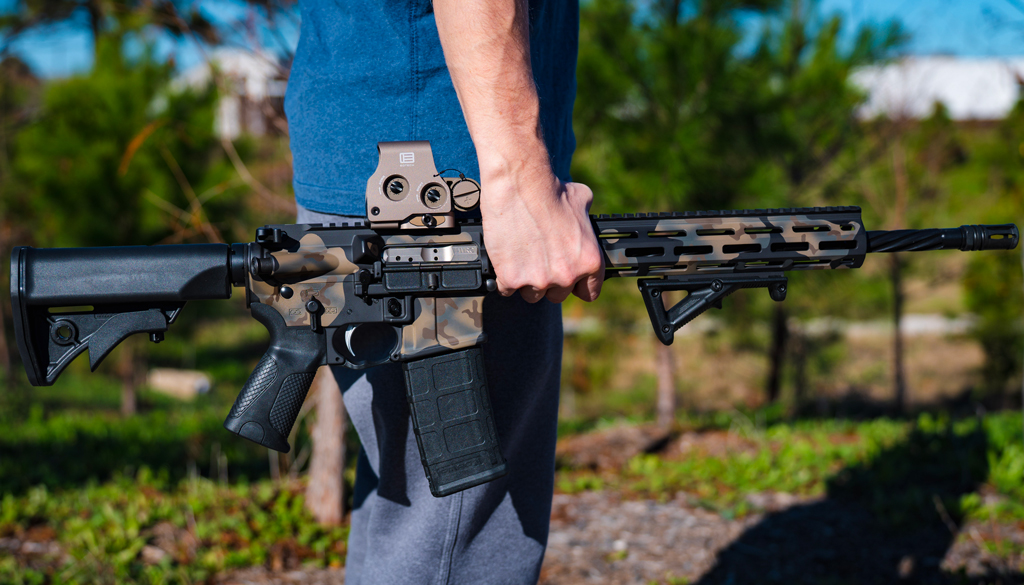
The AR-15 or ‘Modern Sporting Rifle’ is the modern musket of our time and one of the most popular firearms on the planet. The platform’s modularity, ease of use, accuracy, reliability and versatility make it perfect for professionals & hobbyists alike. The AR-15 is mil-spec in nature, allowing for easy customization and personalization at the user level. Here’s the breakdown of the anatomy of these intricate, yet simplistic rifle platforms.

Share this Image On Your Site
- Lower Receiver
- Trigger
- Two-Main Types: Single-Stage and Two-Stage – A Single-Stage trigger consists of a crisp single pull firing mechanism. A Two-Stage trigger features a longer two-part trigger pull.
- Most AR-15 Triggers are mil-spec in nature allowing them to be interchanged between different manufacturers and models.
- The trigger is one of the most important components to the AR-15 and a popular upgrade for enthusiasts.
- Buffer Tube:
- The buffer tube absorbs the rifle’s recoil.
- The buffer tube is a critical component in the cycling and operation of the firearm.
- The buffer tube also holds the rifles butt stock allowing for adjustability
- Magazine:
- The most common magazine capacity is 30 rounds, but a range of lower and higher options are available.
- Most AR-15 magazines are mil-spec, allowing them to be used across different models and manufacturers.
- Most AR magazines today are made of polymer.
- Buttstock:
- Stocks come in all shapes, sizes and colors.
- AR-15 stocks come in fixed, telescoping, folding, and fully adjustable configurations.
- Grip
- The pistol grip helps the operator maintain control of the rifle and improves overall accuracy and effectiveness.
- Most grips are made of polymer and rubber
- Lower Receiver Parts:
- Receiver parts consist of a safety selector, takedown detents, bolt catch, mag catch, trigger springs, roll pin, and disconnector springs.
- Receiver:
- The main receiver housing is made from two types of metal alloys: Billet and forged aluminum.
- The receiver housing features the stamped serial # and is treated as a firearm, requiring the standard ATF background check.
- Upper Receiver
- Barrel:
- Can range from 10.5” to 24”, with the 16.5 being the most common. Barrel must be greater than or equal to 16” to be considered a non ‘short-barreled’ rifle.
- Barrels come in different coatings, linings, weights, rifling, and chambering which all carry unique advantages depending on the rifles application.
- The barrel is perhaps the most important aspect of the AR-15 rifle -responsible for the rifle’s overall accuracy and effectiveness.
- Bolt Carrier Group:
- The bolt carrier group houses the firing pin, bolt, extractor, cam pin, bolt gas rings, and firing retaining pin.
- The bolt carrier group works off gas operation by two main types of action – direct impingement or gas piston.
- Gas Tube:
- The gas tube connects the gas block allowing gas to pass through the bolt carrier, which initiates the cycling of the rifle.
- Charging Handle:
- The charging handle is responsible for chambering the first round into the rifle. It’s also used to clear the chamber.
- Charging handles come in a standard variant, ambidextrous, and extended.
- Handguard:
- The handguard covers the barrel, which allows for an endless amount of accessory options – lasers, flashlights, forward grips, night vision, and more.
- Handguards come in 3 major configurations – Picatinny, KeyMod and M-LOK.
- Handguards come in an assortment of lengths and milspec in nature.
- Ejection Port:
- Ejects the fired spent shell casing. The ejection port also features a door called a Dust Cover.
- Muzzle Devices
- There are 3 different types of muzzle devices, which include muzzle brakes, flash hiders, and compensators.
- These devices help regulate muzzle flash, muzzle rise, and recoil.
- Rifle Sights
- Most AR-15 rifles do not include iron sights, but they are a common accessory. The flip-up sight is the most popular because they can work in conjunction with red dot sights.
- Most users add a red dot sight or tactical variable scope to their AR-15.