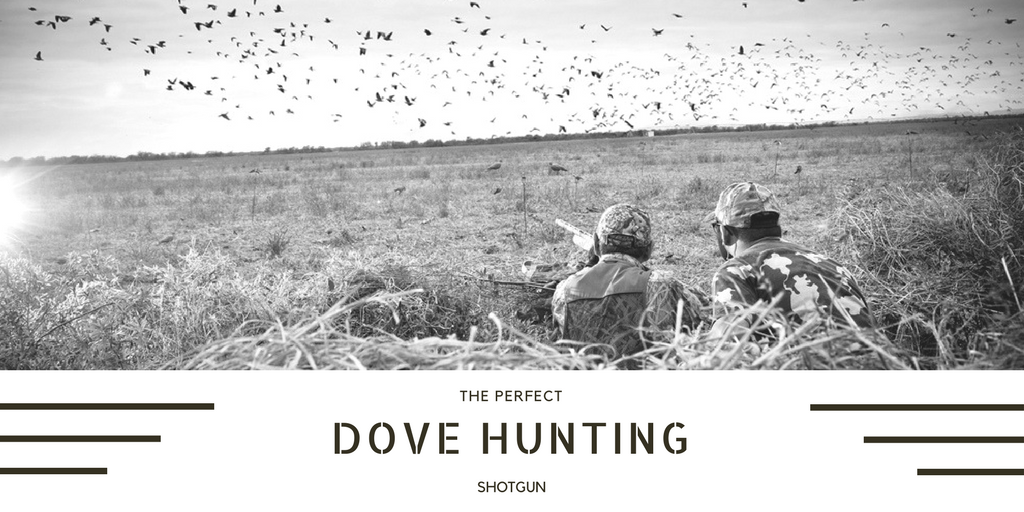
Dove hunting season opens typically in early September. Although dove hunting is one of the simplest forms of shotgun recreation available to wingshooters, most hunters—new and experienced—can find it a challenging and unforgiving sport.
Doves are plump-bodied with short legs and small bills, but their size is definitely to their advantage – their small heads and slender tails don’t allow for tons of surface area to point and aim. They have been clocked at 55 mph and are extremely acrobatic, making sudden ascents, descents and dodges with their pointed tails stretched behind them. Consistently knocking doves down can prove quite challenging.

Another advantage doves have against hunters is their coloration. Mourning Doves, for example, have fairly neutral coloring that incorporates grays, browns, & white and black spots, allowing them to blend in almost anywhere. A couple of giveaways, however, can be their soft coo which can be drawn out, and their wings making a sharp whistle or whinny sound when they take off into flight.
This migratory bird prefers open habitats consistent with prairies, farmland, grassland and lightly wooded habitation. Doves tend to roost in large numbers, and can be found feeding in areas such as good crop fields around cut corn, various wheat fields, peanuts, sorghum, millet, sunflowers and milo. Because seeds make up 99% of a dove’s diet, areas heavy in thistle or croton, as well as roadsides, are also good dove scouting areas.
The Mourning Dove is the most widespread and abundant game bird in North America, with an estimated population of 350 million in the U.S. alone. Every year, hunters harvest more than 20 million.
Choosing the Right Loads for Doves
Because doves are small, the novice hunter might be fooled by thinking “the smaller the better” in regards to firearms and ammunition.
However, small gauge shotguns in this instance would be a recipe for ammo expenditure. For doves, the most common and recommended shot pattern is around 230 pellets for pellet strikes in a 30-inch circle. With that in mind, the following gauge and shell load sizes will get you there:
- 2 ¾ inch shell
- 12-gauge 1 ounce of #7 shot (steel), 1,300 fps
- 12-gauge 1 1/8 ounces of #7 ½ or #8 shot (lead), 1,180 fps
- 20-gauge 7/8 ounce of #8 shot (lead), 1,200 fps
Anything from a #7 shot to a #9 shot will also work well with doves—it just depends on the weight and size of the birds (keep in mind that doves will be heavier later in the season).
Steel shot and high brass does an excellent job with doves, as they provide a great combination of high velocity and pellet count, which helps to ensure that you will hit the mark with shorter leads.
What Choke Should Your Dove Hunting Shotgun Have
There is no single best choke for dove hunting; however, there are a number of chokes that will feel the best to you.
Chokes are positioned at the muzzle, and have allowed shotgun hunters to gain greater efficiency when shooting at distances beyond 25-30 yards. While the material and design of the pellets matters, chokes create a tighter pattern to quickly kill game or destroy a target.
There are two types of chokes: “fixed,” which would be used on older shotguns, and “interchangeable,” which screw into the barrel near the muzzle. As expected, interchangeable chokes are more commonly used with modern firearms, allowing hunters to swap between multiple choke options based on their particular hunting goals.
The two most popular chokes used for hunting dove is the modified choke and the improved cylinder choke.

Here is a list of chokes that that may be used:
Cylinder Choke
Cylinder chokes are useful for close shooting scenarios, such as hunting doves near a waterhole or when they are flying by at 15 to 25 yards from your position. With a bore which has no restriction, the shot string spreads quickly and uniformly.
Improved Cylinder Choke
An improved cylinder choke is an excellent choice and one of the most popular for dove hunting. It enables pellets to create a widespread pattern for fast birds and effective at a range of 25 yards.
Modified Choke
A desirable choice for pass shooting at random distances, the pellets stay clustered longer. A modified choke is appropriate for all-around use, especially when using steel shot to hunt doves. The modified is an effective choke and a good choice for ranges up to 35 yards.
Full Choke
The full choke creates the tightest barrel constriction, which results in the smallest spread pattern at close range. This type of choke is rarely used for dove hunting based on its power and the pattern being too tight to hit close moving targets. However, if you are forced to hunt doves at a greater range the full choke can help keep that pattern full for longer distances. The full choke is effective for hunting dove up 40-45 yards.
Make sure to factor in the choke’s pattern spread when considering a choke for your dove hunting firearm. Here’s the quick breakdown:
- Cylinder – 40-inch spread at approx. 25 yards
- Improved Cylinder – 40-inch spread at approx. 30 yards
- Modified – 40-inch spread at approx. 35 yards
- Full – 40-inch spread at approx. 40 yards
Keep an eye out for the pattern that the choke creates, as well as the pattern’s evenness. If the patterns are not the right size or dense enough to kill a dove, you’ll want to tighten or loosen your choke. If the pattern is not distributed evenly, there may be an issue with pushing too much lead through too constricted a choke. This issue can be solved by using less lead and loosing the choke so you can be more effective.
Finding the perfect choke is, like gun fit, something that should best suit your needs. Practicing at the range and experimenting with different types of chokes will ultimately yield great payoff. Keep in mind that the closer you are to the doves the more effective you will be. The average dove shooter will bag about twice as many birds at 25 yards than he will at 40 yards.
Choosing the “Perfect” Dove Shotgun
There is no perfect shotgun for hunting dove, and the choices are endless. Pump actions, semi-autos and over/unders are all very popular with dove hunters. It really depends on your budget, personal taste and needs.
Dove hunting is often thought of as a gentleman’s sport, which makes the over/under shotgun a favorite among many hunters. These shotguns typically feature beautiful walnut stocks and engraved receivers. They also have two barrels, allowing the hunter to use different chokes in each barrel if desired, which can be beneficial with changing hunting conditions.
Semi-Auto shotguns are also popular for dove hunting, allowing hunters to put more rounds down range at a time.
No matter what type of shotgun you choose, it’s important the shotgun fits you properly and that you are comfortable shooting it. You will want a shotgun that is lightweight but also heavy enough to help diminish recoil, while also providing enough weight to swing with smooth efficiency without being too heavy so that you can keep up with a dove’s elusive maneuvers.
The following shotguns on this list are some great choices when considering a dove shotgun:

- Browning Citori 725 Field #40720 – John M. Browning has marked the industry as the “World’s Greatest Gun Inventor,” and the Browning line of firearms continues to manufacture world-class firearms. This performance-engineered, low-profile design gets your eye closer to the axis of the barrel, making you more one with the gun so you can put more pellets on your target. The Browning Citori employs the concept of Total Barrel Dynamics with lengthened forcing cone and back-bored technology for increased shot velocities, uniform patterns and reduce felt recoil. The FireLite Mechanical trigger reduces take-up so you get a crisp break and shorter over-travel for immediate second shot capability. The Browning Citori also comes with an Inflex II Technology recoil pad, which provides better recoil protection. This model continues to keep comfort in mind with its internal directional deflection construction, which moves the comb down and away from your cheek for superior shooting comfort and quicker, more precise follow-up shots.

- Mossberg 500 All Purpose Field #25374 – The 500 Mossberg is a versatile shotgun platform that comes in a wide assortment of specialty stocks, patterns and finishes to match your hunting needs. The lightning pump action adjustable trigger system has a skeletonized blade, is creep-free and is also user-adjustable from 3 to 7 pounds. Its features include dual extractors, positive steel-to-steel lockup, twin action bars and an anti-jam elevator all seamlessly melded together to ensure smooth operation.

- Winchester Model 101 #25751 – A quick handling, easy swinging over and under shotgun matched with the legendary handling and styling that Winchester is known for, the Model 101 offers the classic, finely cut walnut stock inlaid with the craftsmanship of engraved steel. An adjustable trigger shoe lets you fine-tune its fore and aft position so that you can achieve your perfect length of trigger pull. The decelerator recoil pad reduces felt recoil to very manageable levels and provides for a snag-free heel against your shoulder. This over/under shotgun provides the shooter with the ability to use a combination of choke tube systems either flush-mounted or extended. Chrome plate chambers and bores provide for excellent protection against wear and tear caused by heavy shooting and thousands of shells. The Model 101 locking lugs provide more contact surface for an action that’s build strong and made to last. Lastly, the barrel uses back-bored technology for creating tighter, more consistent patterns.

- Remington 1187 Sportsman #25544- The 1187 Sportsman is a blend of speed reliability, smooth operation and performance. This is a workhorse shotgun, designed to be used and abused yet function flawlessly in the harshest of conditions. Features include a solid steel receiver, 28” vent rib barrel, single bead sight and Mossy Oak New Break-Up Finish. This is a great all in one shotgun that would work great for upland or waterfowl bird hunting.

- Browning A5 Hunter #40709 – The A5 Hunter is a rugged, high performing autoloader yet sophisticated and elegant. Its ruggedness starts with it’s short-recoil operated action that is guaranteed over 100,000 rounds. The A5 features a beautiful Grade I Turkish walnut stock, high gloss 28” vent rib barrel and polish black receiver. This is a great choice for someone looking for the lethal power of an autoloader but appreciates the beauty of a classic over/under style of shotgun.
Dove hunting experts typically choose to hunt doves with a 12-gauge or a 20 because they provide you with more shotguns and ammo variations to choose from. If you are just getting started or recoil sensitive, a 28 gauge shotgun will serve you just fine so you can get used to feeling out the recoil, shot and choke options.
As always, with the right gun and equipment, dove hunting is a pleasurable way to enjoy a great wingshooting sport—just make sure to bring the right gear.
Dove Hunting Shooting Tips
When shooting at doves, remember to pass up low-flying birds to avoid potentially striking a fellow hunter. This is vital for hunter safety, as low angled shots could put your pellets flying toward another hunter’s position.
It is also important to understand that effective bird hunting requires a very specific and proper combination of knowledge and skill. Keep in mind that bird hunting is completely different from shooting at a stationary object where you are required to aim and hit the target with perfect alignment. As with hunting any living creature, there are particular factors to be aware of, such as hunting ground, environment and the specific bird’s movement patterns and social behaviors.
As mentioned earlier, doves move swiftly. If you want to be successful, you must allow your eyes to lead to where you think the birds will be going, then point your shotgun and shoot. You will have almost no chance to aim, as doves tend to fly in various patterns. The lesson here is that the gun will shoot to the pointing area of your focus, and the ability to feel the lead will help you be effective and successful in the field.
Leading, as it relates to dove hunting, is knowing where the bird is going to be after you have pulled the trigger of your shotgun. The two most common methods of leading targets at long distances are the swing-through method and the sustained lead.
Swing-Through Method:
The thing to understand when trying to hit a moving target is that you must swing with the target and fire at the blank space in front of the target. If you stop your swing, you will be sending pellets flying through the air behind your quarry.

An experienced and practiced hunter can estimate the length of the lead necessary to hit the moving target and maintain the lead as they swing with the target. Dove hunting will require you to fire shots and continue the swing and firing process. You will pull up on the bird, keep your cheek firm to the stock and fire as the barrel swing covers the quarry, and then continue to swing and fire.
Sustained Lead:
There are a few things to keep in mind if you are going to try and hunt using the sustained lead method. First, overstate your lead before you make the shot when dove hunting. Overshoot as if you are going to miss.
You’ll shoot at most doves as they cross in front of your field of view, so work at overstating you lead by 6 feet or more. This roughly means that your barrel needs to be 6 inches in front of the dove when firing. One inch of barrel movement is equal to about one foot of distance when you’re shooting targets in the air.
When the bird is flying away from you, shoot a few inches below the bird, which also translates to shooting in front of it. If you picture the dove floating on your gun barrel as you engage the trigger, that should yield success.

Distance, speed and the pattern spread of your ammunition will determine if you’ll hit the bird as it is moving. That is why it is so important to have the right combination of gauge, shot, shell and load. If you are missing birds, then you need to change something in that combination.
As with all hunting, try to remain unseen as best you can. Doves have keen eyes so wear camouflage and blend in with the environment. When a group of doves fly by, don’t just randomly start shooting at the mass; instead, focus on one bird and stick with it until it tumbles.
Dove decoy placement can help with luring. By placing dove decoys near your stand, you can entice birds to fly by at close range.
Hinterland Outfitters offers an excellent selection of decoys, including shell, full-body and moving robo-dove decoys. Choosing which type to use depends on your feel for your dove hunting environment and what you think will work best.
Understanding dove habits will assist you in pinpointing locations. Keep an eye out for good seed areas and watering holes, then explore the area leading up to prime dove-hunting season so you’ll be ready and waiting for them. However, with watering holes, it’s best to keep to the flyways and not hunt at the watering hole’s exact location—that way, you won’t disturb or ruin a good spot.
All in all, equipment and preparation-wise, dove hunting is simple. Once you get out there, get ready for some fast-shooting fun action with this time-honored hunt.
Purchasing a Shotgun and Ammunition for Dove Hunting
Hinterland Outfitters simplifies the process of buying shotguns and ammunition. We’re proud of not only the quality of brands we offer, but our ability to provide expert and industry-leading customer service to help you with your firearm needs at affordable prices.
Contact us for help deciding the right dove shotgun type and ammunition needed for the shotgun’s intended use. We recommend looking over our How to Buy Guns Online information page, but feel free to email us at sales@blog.hinterlandoutfitters.com or call us toll-free at 877-446-8370 to speak with one of our knowledgeable firearms specialists. We look forward to assisting you, and wish you a happy dove hunting season.