
Hunting decoys are life-size imitations of wildlife that have been used by hunter-gatherers for centuries to attract and take game, varmints or predatory animals. Today’s man-made decoys realistically imitate a wide array of wildlife species, including waterfowl, deer, wild turkey, varmints and more.
Ancient archers using bows to shoot at ducks, geese and other waterfowl soaring overhead found the high-flying birds were almost always beyond the reach of their arrows. The hunters eventually discovered that the problem could be overcome if the birds were somehow attracted to come within shooting range. Crude imitations of waterfowl shaped from wood or cork with painted heads and covered in feathers were floated in bodies of water or placed in feeding fields beneath migratory flyways. The hunters found the imitations managed to attract some curious birds, and the result was a primitive forerunner of today’s waterfowl decoys.
Although the concept remains the same today, the rustic imitations have been replaced with realistic-looking decoys made primarily from painted synthetics or canvas. Some handmade duck, goose, teal and other waterfowl decoys are considered to be a form of folk art and are collected by both hunters and hobbyists.
Decoys used for hunting go far beyond waterfowl. They’re also used to attract and take wild turkey, large game animals including deer, elk and moose, and for hunting fox, coyotes and other varmints. Here’s a quick overview of some types of hunting decoys and how they’re used:
Waterfowl Decoys
Ducks, geese and other migratory waterfowl are normally hunted in the fall and early winter months when the birds leave the cold of Alaska and Canada and fly south to spend the winter in warmer climates before heading back north in the spring. Here are the four primary North American migratory flyways:
- The Mississippi Flyway, which extends from central Canada to the Gulf of Mexico
- The Atlantic Flyway, which runs along the Atlantic coast from Canada to Florida
- The Central Flyway that waterfowl follow from Alberta and Saskatchewan to Texas and Mexico
- The Pacific Flyway that runs from the middle of Alaska to southern Mexico.
Duck Decoys
When hunting ducks on or near bodies of water, the hunter, often accompanied by a dog to retrieve downed birds, is concealed within a camouflaged enclosure called a blind to reduce the chance of being spotted by flocks of game birds flying overhead.
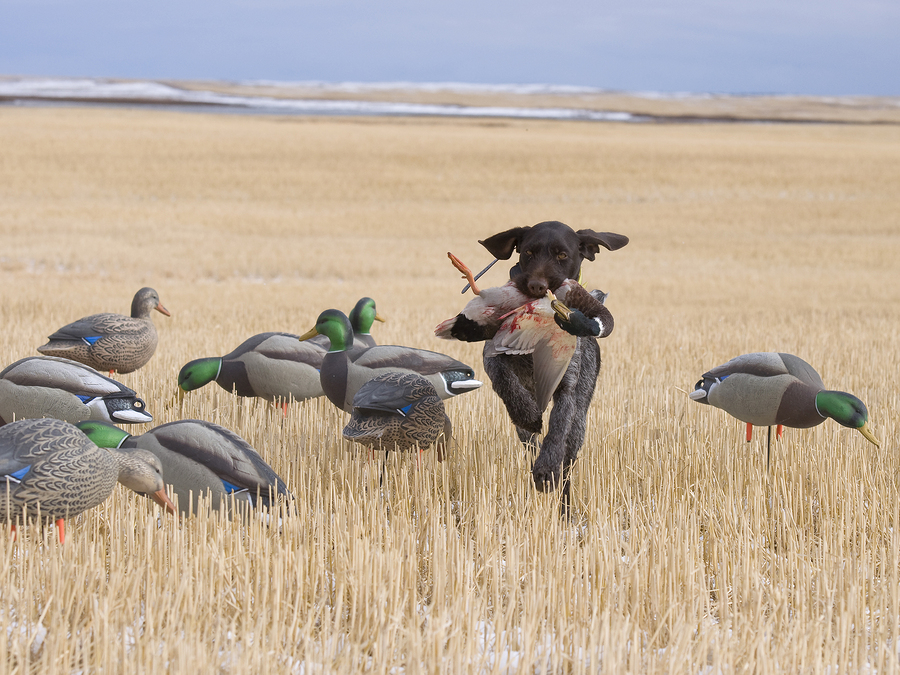
The hunter tries to attract game toward the blind by using a duck call to imitate the sound made by a live bird. To further persuade some of the flock to come within shooting range, clusters of floating decoys made from wood, canvas or molded plastic are joined together by a line and floated in the water. Known as “spreads,” the strings of decoys are placed in the water 30 or 35 yards from the blind, which leaves an open area the incoming birds perceive to be a safe place to land. These decoy spreads are anchored at one or both ends to keep them from drifting away in the current or being blown away by the wind. A good example of a floating decoy is the Mojo Mallard.
Other decoys:
- Rippler Decoy
- Butt Up Rippler Decoy
- Baby Mojo Mallard
- Drake Floater Mallard
- Baby Hen Mallard
- Teal Decoy w/ Support Pole
Spreads may contain as few as four or five decoys up to a string of as many as a hundred or more. Since ducks always land into the wind, wind direction plays an important role in the placement of the spread. Spreads should contain an assortment of colorful, highly visible drake and hen decoys of the species being hunted, along with a few goose and other decoy types added to give the simulated setting a more realistic touch. Decoys of wary local nongame birds, such as herons, coots, loons and egrets, are also often added to the mixture. Known as “confidence” decoys, their presence sends an “all clear” message to the ducks flying overhead. Canadian geese, because of their inherent wariness, are the most commonly used of all confidence decoy types.
Goose Decoys
As with duck hunting, goose hunters also use imitation sound calls and decoy spreads to attract their prey to be within shooting range. Geese, however, fly higher, and their flight patterns are different than ducks. Goose hunting takes place either on or near open bodies of water such as lakes, rivers, marshes or ponds, or in open fields of corn, wheat, barley or other grain crops. Geese are cautious by nature, which means decoy spreads that succeed in attracting geese must be set out in a realistic and convincing manner.
When hunting geese from fields, hunters set themselves up in ground blinds within stands of crops surrounded by land decoys, which are different from the floating decoys used for hunting from blinds on or near water. Land decoys depict geese standing and feeding in a field, along with a few “wing flappers,” which are goose decoys with fluttering wings driven either by batteries or gusts of wind.
Another technique for hunting geese in fields involves the hunter lying motionless on his or her back in a layout blind, which is a camouflaged cover that conceals the entire body with the exception of the hunter’s eyes. When the hunter spots geese about to land, the blind’s cover is thrown open in preparation for firing at the incoming geese. With properly positioned decoys and an adequately concealed hunter, geese will sometimes land literally within a few feet of the layout blind.
Decoys for Hunting Wild Turkey
In most regions, there are both spring and fall seasons for hunting wild turkeys. Bow and shotgun hunters dressed in camouflage clothing either sit in ground blinds or conceal themselves just inside the perimeters of openings or clearings that border stands of trees or heavy underbrush. The hunter tries to attract the wild birds using artificial calls to imitate their sounds, along with a series of strategically placed artificial decoys.
The three categories of decoys for hunting turkey are the female hen, the adult male tom, or gobbler, and the jake, which is a young male. Jakes are distinguished from toms by their shorter beards. Jakes also have longer middle tail feathers than toms, whose tail feathers are all the same length. Another distinguishing feature are a tom turkey’s breast feathers, which are longer than a jake’s.

The three main types of turkey hunting decoys are flat, 2-dimensional cardboard silhouettes, lifelike stuffed decoys and 3-dimensional inflatable turkey replicas. Made from cardboard, 2-dimensional decoys are inexpensive, but are only effective if the decoys face head-on toward the direction from which the turkeys approach. Silhouettes are lightweight and easily transportable, but being made from cardboard, silhouettes don’t hold up well in wet weather.
Stuffed decoys are the most lifelike of the three types, and are also the most expensive. Some stuffed decoys aren’t plastic or fabric imitations, but rather are actual turkeys that have been preserved by taxidermists for use in the field. Stuffed decoys are heavier and less portable than the other two turkey decoy types.
Inflatable decoys made from vinyl are the most commonly used type of decoy for hunting wild turkeys. They look more realistic than 2-dimensional cardboard silhouettes, and are less expensive than stuffed decoys. Since they’re collapsible, they’ll fit in a backpack and are easy to carry to the hunting ground.
Proper placement of the decoys is crucial to a successful turkey hunt, and the configuration will vary with the situation. Walking decoys, such as a Strut Lite Hen Turkey lined up in a row, give the appearance of wild turkeys entering or leaving a field or clearing. The most frequently used set-up for hunting wild turkey is randomly placing several hen decoys in a field with their heads pointed toward the ground to give the appearance of a group of feeding birds. A good example is the Penny Snood Feeding Hen Turkey decoy.
Regardless of whether the decoys are set to simulate walking or feeding birds, toms and jakes should always be placed behind the hens. A tom decoy strategically positioned behind one of the imitation hens to simulate mating should, if correctly positioned, attract more eager toms, along with a few aggressive jakes willing to fight a tom for the hen.
From camouflage outerwear to turkey calls and lifelike decoys, everything you’ll need to hunt wild turkey is available online from Hinterland Outfitters.
Large Game Decoys
Whether hunting deer, elk or other large game with a bow, rifle or shotgun on the ground or from a stand, properly positioned lifelike decoys can make the difference between a successful hunt or a day without firing a shot. Here’s information on some large animal decoys and how to use them:
Deer Decoys
Deer decoys are available as full-bodied, 3-dimensional imitations of standing bucks or does, partial body bedded down deer or 2-dimensional silhouettes. Some higher-end decoys have lifelike artificial skins stretched over life size, anatomically correct molded plastic bodies.
Modern day inflatable deer decoys are lightweight and compact enough to easily fit into a backpack. Inflatable decoys are made from rubber, vinyl or plastic, which, when deflated, makes them easy to carry to remote locations or through rough terrain. An example is the Tinks Inflatable Miss November doe decoy.
Some deer decoys have movable heads and tails activated by wind, which give them an even more lifelike appearance. Other features that can add realism to deer decoys include a rear leg that will hold scent pads for attracting game, and front legs for holding electronic deer call systems. Electronic calls are illegal in some states, so check your local regulations. Some deer decoys have interchangeable sets of ears to simulate states of alertness or submissiveness.
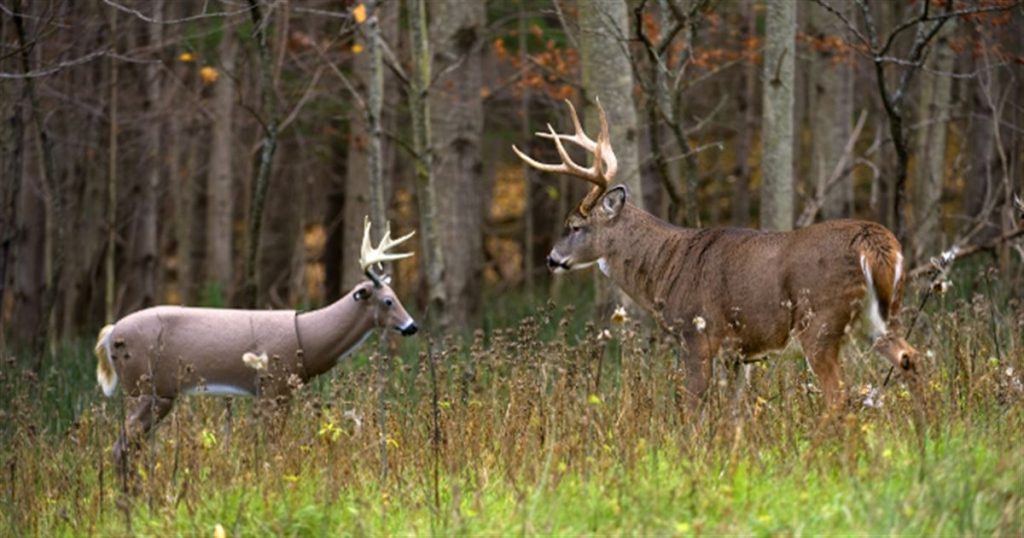
A decoy can bring an out-of-range deer in close enough for a clean shot, since it will be concentrating on the decoy rather than being on alert for a hunter or predator. The further away the deer can see the decoy, the better the chances are it will be curious enough to approach and investigate. Edges of stands of timber where deer are likely to enter or exit meadows, or pastures in early mornings or late afternoons, are good locations for setting up a decoy.
Whenever possible, place a deer imitation on a ridge top that’s easily visible from a distance and near a clearing adjacent to a wooded area where deer are likely to cross. Positioning a decoy at the edge of a heavy stand of timber along a logging road where it can be seen by deer crossing the road in either direction is also a good choice.
Decoys should be placed upwind from — and angled toward — the hunter’s elevated deer stand or concealed ground position. A live buck will almost always approach and encircle a buck decoy from downwind before encircling and coming to face it head-on. Since the decoy is positioned facing upwind, the deer will then be between the decoy and the stand, which gives the hunter a closer shot. A doe decoy should be placed upwind, but faced away from the hunter, since, for obvious reasons, this is the portion of the doe’s anatomy that most interests the buck.
Elk Decoys
Hunting elk with decoys is similar to using decoys to hunt deer. Some elk hunters partially conceal the decoy behind trees, since elk are curious by nature. They’re attracted to and focus on the eyes and ears of other elk they encounter, and when they glimpse only portions of the decoy, they’ll sometimes approach it for a closer look. Partially concealing the head of a cow elk decoy behind a tree will often be enough to keep a bull elk moving toward the decoy.
Bull elk are much like tom turkeys, in that they enjoy showing off for the opposite sex, particularly by standing in clearings at daybreak and bugling to attract cow elk. An effective approach is to place a decoy 10 or 15 yards into the meadow just before sunrise and hide within the edge of the surrounding woods. When a bull enters the open clearing, the hunter tries to bring him closer by using a hand call to imitate the sound of a cow elk.
Standing or kneeling motionless from positions just inside standing timber on the edge of a clearing, some compound and crossbow hunters conceal themselves behind partial body elk decoys with openings for spotting game and shooting. The lightweight, collapsible decoys are attached to the bow with Velcro straps, which leaves the hunter in full control of the bow at all times. When the hunter sees a curious elk come within shooting range for a closer look at the decoy, he or she fires through the window. Shooting window decoys are also available for hunting moose, mule and whitetail deer, antelope and wild turkey. A major downside of a hunter concealed behind this realistic-looking decoy type is the possibility of a rifle hunter in the distance mistaking the decoy for live game and firing at it, potentially seriously injuring or perhaps even accidentally taking the life of the hunter.
Predator Decoys
Decoys are used for hunting more than game. They’re a valuable tool used by hunters and landowners to control populations of North American coyotes, fox, wolves or similar carnivore predators.
Preying upon small, farm-like calves or lambs and domesticated animals such as household pets, coyotes are quick, cunning and cautious, and present a challenge to even the most experienced hunters. Coyotes begin stalking their prey from long distances, and are attracted by movement. Hunters bring them within shooting range using motion decoys similar to the Mojo Critter, which is a battery-operated device with realistic-looking artificial fur attached to a cable that flops and spins intermittently when the hunter activates it remotely. Placed 50 or 60 yards from the concealed hunter, the decoy is usually used together with either a handheld or electric call placed alongside or built into the decoy, which the hunter also controls remotely. To a coyote, the spinning faux fur appears to be the tail of a wounded or crippled animal that can be easily taken for its next meal. When the decoy isn’t in motion, a coyote will sometimes mistake the fur for the tail of a dead animal, which is also appealing since coyotes are scavengers. Once the coyote is within range, the hunter takes the shot. Other decoys that are effective in attracting coyotes emulate distressed rabbits or newly born fawns, both of which are coyote diet staples.
Decoys and methods for hunting foxes are similar to those used to attract coyotes. Other predators hunted using decoys and calls are bobcats, feral hogs and raccoons.
Shopping for Decoys
Whether you hunt with a rifle, bow or shotgun or you’re after waterfowl, big game or varmints, using decoys will add a new dimension to your hunting experiences and success. Hinterland Outfitters has a complete selection of decoys, calls, scents and accessories for sale online to match the prey being hunted. Check out our full selection of animal decoys online, or call us toll-free at 877-446-8370 or email us at info@blog.hinterlandoutfitters.com. One of our knowledgeable associates will be pleased to answer your questions regarding decoy hunting techniques and equipment, like red dot sights for shotguns.
For more informational content on hunting, see the related blogs below: